Here's what happened.
I had some dukkah, sitting in a jar, beckoning me daily from the counter top. I had made a batch for the season-end Hudson Farmers' Market potluck dinner, but, I'm not going to lie to you, Farmers' Market friends: I didn't bring the whole batch to the potluck. I purposely held back about half of it. Because I wanted to "share" some with Husband. But really I wanted it for myself. You, Farmers' Market friends, are OK with this, I am certain, as there were many other delicious things to eat that evening. The real loser here is Husband. But he is already a loser! We have established this.
Anyway.
Then just a few days later I was ambling through the grocery store -- chatting up the beer guy as I am wont to do, checking out various cheeses, wondering if I need to buy any baked goods (yes) -- when I spied a perilous pyramid of delicata squash, arrayed beautifully next to the rest of fall's bounty: jugs of local cider, apples in every shade of green and red, wee pumpkins. I bought them. The delicata squash. Because I couldn't not. They were lovely.
A few more days passed. The delicata squash decorated my kitchen counter, not my dinner plate, because I didn't know what I wanted to do with them. Roasting them is always a solid option, but I wanted a little more oomph. I desired a recipe that felt special -- something befitting the delicata's stripey good looks and seasonal charm.
Enter Deborah Madison and her book, Vegetable Literacy. I thought it would behoove me to see what her tome had to say about delicata squash. Guess what? Vegetable Literacy contains a recipe for delicata squash prepared with dukkah! I get irrationally thrilled when I come across a recipe that incorporates something that is otherwise languishing in my larder -- you can, therefore, imagine my elation at a dish that incorporates two such foodstuffs.
I said to Husband: you are having squash and dukkah for dinner.
++++++
ROASTED DELICATA SQUASH HALF-ROUNDS WITH DUKKAH AND TAHINI-YOGURT SAUCE
Adapted from Vegetable Literacy, by Deborah Madison
Ms. Madison's book includes her own recipe for dukkah, but I fall back on my favorite standard.
2 Delicata squash, 1 1/2 to 2 pounds total, the skins left on
1 T. olive oil
Sea salt
1 clove garlic
1/2 c. Greek yogurt
3 T. tahini
1/4 c. dukkah
1 T. fresh parsley, finely chopped
Preheat the oven to 400 degrees Fahrenheit. Slice each squash in half lengthwise and scrape out the seeds (I like to use my grapefruit spoon for this job). Slice each half into half rounds about 1/4 inch thick.
Toss the pieces with the oil and season with sea salt to taste, then arrange them in a single layer on a baking sheet.
Roast until the squash is tender and browned in some places, 20-25 minutes.
While the squash roasts, make the tahini-yogurt sauce. Mince the garlic, mixing it with about 1/4 t. of sea salt on the cutting board until the garlic and salt form a smooth paste. Stir the garlic mixture into the yogurt, then stir in the tahini. Taste, and add more salt if necessary.
When the squash is tender, remove it from the oven and toss it with the dukkah and parsley.
Serve alongside a generous dollop of the tahini-yogurt sauce.
Serves 4-6, as an appetizer or side.
++++++
Previously, on A Stove With A House Around It:
One year ago: maple-stout bread
Two years ago: fig-walnut pie
Three years ago: apple and cheddar scones
Four years ago: caramelized onion and brie mashed potatoes
Five years ago: cauliflower and fregula Sarda gratin
Showing posts with label Thanksgiving. Show all posts
Tuesday, November 19, 2013
Friday, December 2, 2011
Now there are four
I am Anti-Leftovers.
Husband loves them. Loves them so much that he affectionately calls them "lefties." While he will happily eat week-old chana masala for breakfast, the leftover has to be something special indeed for me to dig into it. Even one of my favorite foods in the world -- Mom's stuffing -- is languishing in its leftover form. I can't even think of a single thing that I truly enjoy the second time around. Oh. Turkey tacos. But that's it. I think maybe it's a mental problem.
| Who wants this? I don't. |
My vigorous Anti-Leftover stance reaches epic proportions around Thanksgiving time, when one is not only flooded with the leftovers themselves, but with 8,342,361 recipes for how to use them. Food magazines, food TV, food Internets, food iPad apps, all falling over themselves to inspire you to make a stuffing frittata or a turkey chili named after Guy Fieri's son. In my mind, there are exactly three things to do with Thanksgiving leftovers: (1) reheat and enjoy them as they are, if you must; (2) make a turkey sandwich; and (3) make turkey stock. (Actually, the stock is required. But that is another post.)
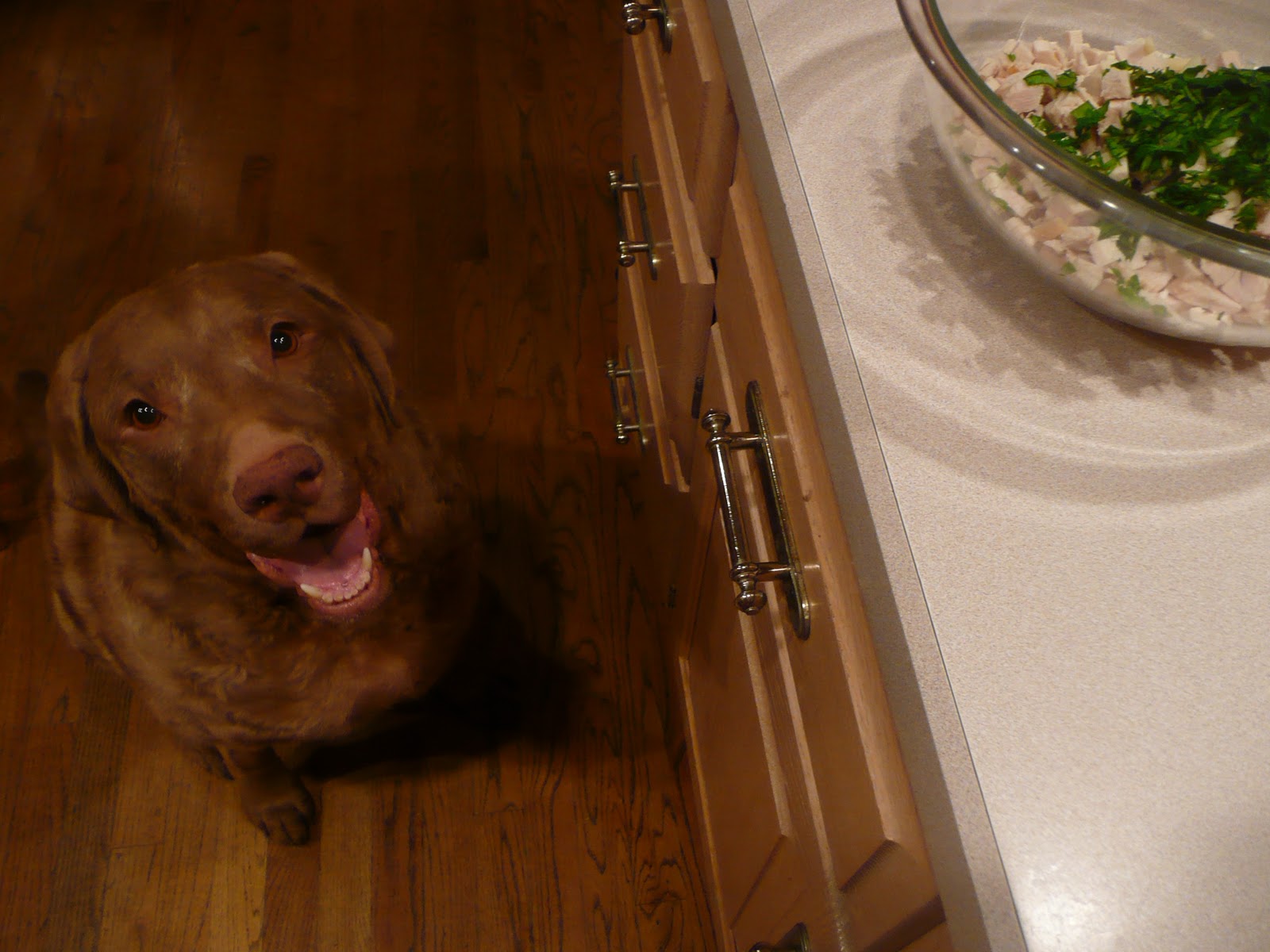
But now there are four. Welcome to the only recipe that utilizes Thanksgiving leftovers that I shall countenance: TURKEY COOKIES. FOR THE DOG.
This recipe is just perfect: making it ensures that no turkey will be wasted, as you can wait until the Pro-Leftovers people in your house have their fill, then use the remaining scraps for these "cookies." (I can't bear to waste meat -- an animal gave its life for what's on that plate, it's not right to throw any of it away.) Even if it's a day or so past its prime, I assure you, your pup won't care. As long as your best friend isn't on a restricted diet that would prohibit any of the component ingredients, this is a healthy doggie treat, made with love, that will make your companion love you even more than she already does.
And it will make me love you, because you are being rational about Thanksgiving leftovers. And I know how you crave my approval.
P.S. I am not alone in my T-giving leftover disdain: my rigid worldview was bolstered this year by a writer for Slate.com, Jill Pellettieri, who makes a persuasive and dare I say definitive case against Thanksgiving leftovers in a piece titled, "Let Leftovers Be Leftovers." Jill reasons: you wouldn't make a turkey quesadilla suiza any other day of the year, so why must you on the last Friday of November? Additionally, and most compelling, she advocates eschewing leftovers because one should keep the special and ceremonial Thanksgiving meal just that -- special. If you are going to spend most of November preparing for a single meal, why would you not enjoy what's left of that meal as it is? Why cobble it into something else, be it a pot pie or a hash or a soup? If you love Thanksgiving food so much as to spend the better part of a month making it, why discard it so callously after just one plateful?
"We spend weeks planning for Thanksgiving dinner. We travel great distances to enjoy it with loved ones. We postpone diets to gorge ourselves. We may even fast all day to make room for one more slice of pumpkin pie. Why not enjoy the leftovers for what they are, a delicious continuation of that feast? Why replace these rituals with recipes that are not only ridiculous, but create more work? Let Thanksgiving live out its natural life—you'll know when it's time to move on."
It's a good argument, I tell you, and Jill, I want you to be my new bestie.
++++++
TURKEY COOKIES
Adapted from a recipe that appeared in my local vet's newsletter
2 c. cooked turkey, cut into a small dice
3 T. grated cheese (my pup Jet likes sharp cheddar)
1 T. fresh parsley, chopped
4 eggs
2 c. whole wheat flour
2 T. nutritional yeast (or brewer's yeast)
2 T. vegetable oil
Preheat the oven to 350 degrees Fahrenheit. Line a baking sheet with parchment paper. In a medium bowl, combine the turkey, cheese and parsley. Mix well. In a separate bowl, beat the eggs and pour over the turkey mixture.
Add the flour, nutritional yeast and oil. Using your hands, mix until the ingredients are thoroughly combined and the mixture resembles a dough ball.
Using a spring-loaded scoop (or two spoons), portion the cookies, rolling each into a ball. Place on the prepared baking sheet. Using the bottom of a small juice glass, gently press each ball into a flat round about 1 inch thick.
Bake for 18-20 minutes, until the cookies are brown and firm. Remove to a wire rack to cool completely; feed to best friend.
Turkey cookies must be stored in the refrigerator.
Makes about 2 1/2 dozen.
2 c. cooked turkey, cut into a small dice
3 T. grated cheese (my pup Jet likes sharp cheddar)
1 T. fresh parsley, chopped
4 eggs
2 c. whole wheat flour
2 T. nutritional yeast (or brewer's yeast)
2 T. vegetable oil
Preheat the oven to 350 degrees Fahrenheit. Line a baking sheet with parchment paper. In a medium bowl, combine the turkey, cheese and parsley. Mix well. In a separate bowl, beat the eggs and pour over the turkey mixture.
| "I hear these can also be served to cats. But I don't know nothin' 'bout no cats." |
Add the flour, nutritional yeast and oil. Using your hands, mix until the ingredients are thoroughly combined and the mixture resembles a dough ball.
Using a spring-loaded scoop (or two spoons), portion the cookies, rolling each into a ball. Place on the prepared baking sheet. Using the bottom of a small juice glass, gently press each ball into a flat round about 1 inch thick.
Bake for 18-20 minutes, until the cookies are brown and firm. Remove to a wire rack to cool completely; feed to best friend.
Turkey cookies must be stored in the refrigerator.
Makes about 2 1/2 dozen.
++++++
Previously, on A Stove With A House Around It:
One year ago: apple and cheddar scones
Two years ago: kaiser rolls
Three years ago: turkey meatballs
Saturday, November 12, 2011
Dear fig-walnut pie of '10
This is a pie that I made a year ago.
I was all gung-ho about this pie, creating the recipe and baking it the night before Thanksgiving and then nibbling on it contentedly the next day. I had every intention of sharing it with you last year, but then I was all, "Thanksgiving's over now, does anyone really want to know about a fig-walnut pie? Surely they've moved on to gingerbread and thoughts of reindeer hooves on the roof."
Thus, the recipe and these photos have languished, imprisoned in the tiny jail cell that is an 8-GB SD card. I'd look at them every so often. Hm, I could write about this pie. But it's May! Nobody bakes pies in the spring. And then, Here's this pie again. But it's August! It's a million degrees! Plus, Thanksgiving will be here in no time.
As it is, time flies. And here we are: less than two weeks from Thanksgiving. Time to talk about the pie! Huzzah!
This whole thing came about last year when I was sitting around thinking about how people love pecan pies (myself included), but I never hear anyone talk about a walnut pie. Why not? I demanded an answer. A preliminary Google search told me that walnut pies do indeed exist. There are plenty of recipes out there. But they don't seem to enjoy the same headline-grabbing pie-ttention that their pecan cousins command. I was going to change that, if only for myself and whoever else managed to get a fork in the pie before I devoured it, all un-ladylike.
I threw figs into the mix because I determined that an all-walnut pie might be too overpowering with slightly bitter walnut aftertaste -- which I normally love when I'm snacking on walnuts but that might become too much within the context of a walnut-only pie. I started thinking about where I find walnuts, culinarily. On cheese trays. Next to the yummy veined cheeses. Alongside a fig or two, cut in half to show off their rustic, seeded centers. I almost went down the path of making a savory tart, with the blue cheese incorporated -- maybe I'll do that this year! -- but in the end, baked up a rich, and sweet beauty chock full of walnuts and chewy flecks of dried fig.
And with that, dear fig-walnut pie of '10, I release you from the SD card.
+++++++
FIG-WALNUT PIE
I used America's Test Kitchen's vodka pie crust recipe for this pie, and let me tell you: like everything else America's Test Kitchen does, it was perfect. Easy to work with, flaky, tasty, fantastic. But of course, you may use any pie crust that you love with all your heart.
Please note: if you do go with the vodka pie dough, the recipe makes enough for a double-crust pie, which this isn't. So go ahead and wrap the second disk in several layers of plastic wrap and freeze; it freezes quite well and then you'll be ready for impromptu pie-making. 'Cause that always happens.
Remove the pie shell from the refrigerator and fill about 3/4 full with walnuts. Add the rum-soaked figs -- and any remaining rum in the bowl -- to the filling; stir to combine. Pour the filling over the walnuts and bake for 30-35 minutes. Cool on a wire rack for about 15 minutes before cutting and serving.
I was all gung-ho about this pie, creating the recipe and baking it the night before Thanksgiving and then nibbling on it contentedly the next day. I had every intention of sharing it with you last year, but then I was all, "Thanksgiving's over now, does anyone really want to know about a fig-walnut pie? Surely they've moved on to gingerbread and thoughts of reindeer hooves on the roof."
Thus, the recipe and these photos have languished, imprisoned in the tiny jail cell that is an 8-GB SD card. I'd look at them every so often. Hm, I could write about this pie. But it's May! Nobody bakes pies in the spring. And then, Here's this pie again. But it's August! It's a million degrees! Plus, Thanksgiving will be here in no time.
As it is, time flies. And here we are: less than two weeks from Thanksgiving. Time to talk about the pie! Huzzah!
This whole thing came about last year when I was sitting around thinking about how people love pecan pies (myself included), but I never hear anyone talk about a walnut pie. Why not? I demanded an answer. A preliminary Google search told me that walnut pies do indeed exist. There are plenty of recipes out there. But they don't seem to enjoy the same headline-grabbing pie-ttention that their pecan cousins command. I was going to change that, if only for myself and whoever else managed to get a fork in the pie before I devoured it, all un-ladylike.
I threw figs into the mix because I determined that an all-walnut pie might be too overpowering with slightly bitter walnut aftertaste -- which I normally love when I'm snacking on walnuts but that might become too much within the context of a walnut-only pie. I started thinking about where I find walnuts, culinarily. On cheese trays. Next to the yummy veined cheeses. Alongside a fig or two, cut in half to show off their rustic, seeded centers. I almost went down the path of making a savory tart, with the blue cheese incorporated -- maybe I'll do that this year! -- but in the end, baked up a rich, and sweet beauty chock full of walnuts and chewy flecks of dried fig.
And with that, dear fig-walnut pie of '10, I release you from the SD card.
| (In context, second from right) |
+++++++
FIG-WALNUT PIE
I used America's Test Kitchen's vodka pie crust recipe for this pie, and let me tell you: like everything else America's Test Kitchen does, it was perfect. Easy to work with, flaky, tasty, fantastic. But of course, you may use any pie crust that you love with all your heart.
Please note: if you do go with the vodka pie dough, the recipe makes enough for a double-crust pie, which this isn't. So go ahead and wrap the second disk in several layers of plastic wrap and freeze; it freezes quite well and then you'll be ready for impromptu pie-making. 'Cause that always happens.
For the crust:
2 1/2 c. all-purpose flour, divided
1 t. kosher salt
2 T. sugar
12 T. cold unsalted butter, cut into 1/4-inch pieces
1/2 c. cold vegetable shortening, cut into 4 pieces
1/4 c. vodka, cold
1/4 c. cold water
For the pie:
1/4 c. dried figs
2 T. dark rum
1/4 c. unsalted butter
1/2 c. light brown sugar
1/2 c. light corn syrup
Pinch kosher salt
2 large eggs
12 oz. raw unsalted walnuts, roughly chopped
First, make the crust. Place 1 1/2 c. of the flour, salt and sugar in a food processor and pulse until combined. Add the butter and the shortening and process until a homogeneous dough begins to collect in uneven clumps, about 15 seconds (the dough will resemble cottage cheese curds). With a rubber spatula, scrape the bowl to redistribute the dough around the blade. Add the remaining cup of flour and pulse until the mixture is evenly distributed around the bowl, 4 to 6 quick pulses. Empty the mixture into a medium bowl.
Sprinkle vodka and water over the mixture. With a rubber spatula and using a folding motion, mix the dough, pressing down on it until it is slightly tacky and sticks together. Divide the dough into 2 even balls and flatten each into a 4-inch disk. Wrap each in plastic wrap and refrigerate at least 45 minutes, or up to 2 days.
Remove the pie dough from the refrigerator about 15 minutes before you wish to work with it. At this time, preheat the oven to 350 degrees Fahrenheit. On a
floured work surface, roll out the dough into a 10-inch round (you might need a little more flour than usual if you're using the vodka dough, as it's a bit stickier). Place the
dough in a pie plate, trim and flute the edges and return to the
refrigerator to chill while you assemble the filling.
In a small bowl, soak the figs in the rum. Let the figs sit while you assemble the rest of the filling.
Melt
the butter in a medium saucepan over low heat. When the butter is
melted, remove from the heat and add brown sugar, corn syrup, salt and eggs. Whisk the mixture until well-combined.
Remove the pie shell from the refrigerator and fill about 3/4 full with walnuts. Add the rum-soaked figs -- and any remaining rum in the bowl -- to the filling; stir to combine. Pour the filling over the walnuts and bake for 30-35 minutes. Cool on a wire rack for about 15 minutes before cutting and serving.
Makes one pie.
++++++
Previously, on A Stove With A House Around It:
One year ago: apple and cheddar scones
Two years ago: twice-baked cauliflower
Three years ago: dark gingerbread pear cake
Wednesday, November 24, 2010
This just makes me happy
So it's Thanksgiving eve. I put the 16-pound bird in my traditional Ace Hardware five-gallon poultry bucket, poured over the all spice-, ginger- and black peppercorn-spiced brine, and headed to my parents' house to leave it overnight in their "walk-in" (a.k.a. their screened-in back porch, winterized with heavy duty plastic that keeps it around a perfect 40 degrees).
When I got there, Mom and Dad were kicking it old school:


Dad hasn't made pies in years. Years, I tell you. But when I was growing up, he made pies all the time. In fact, his pie and bread exploits inspired my love of baking. I have him to thank for this little obsession of mine, and it was awesome to see him in full effect. (Mom, for her part, was excelling at one of her most valuable skills: MAKING STUFFING.)
I am thankful for Dad and his pies, and Mom and her stuffing. And Husband. And Jet pup. And, perhaps most of all, little Son.
May you all enjoy this holiday with your loved ones and a big pile of delicious food. Happy Thanksgiving!

When I got there, Mom and Dad were kicking it old school:
Dad hasn't made pies in years. Years, I tell you. But when I was growing up, he made pies all the time. In fact, his pie and bread exploits inspired my love of baking. I have him to thank for this little obsession of mine, and it was awesome to see him in full effect. (Mom, for her part, was excelling at one of her most valuable skills: MAKING STUFFING.)
I am thankful for Dad and his pies, and Mom and her stuffing. And Husband. And Jet pup. And, perhaps most of all, little Son.
May you all enjoy this holiday with your loved ones and a big pile of delicious food. Happy Thanksgiving!
Wednesday, November 10, 2010
Abiding love for an apple
October 25 can never come fast enough. For October 25 is the day each year when the Mutsus arrive.

Do you know the Mutsu? If you don't, I strongly suggest you make its acquaintance. The Mutsu is a tart green apple, a late-fall beauty whose tangy bite slowly gives way, if stored properly, to a subtle sweetness. She's a glory with which to bake, and a treat to eat. I go a little bit crazy waiting for her each year, counting down the days until the end of October, bypassing the lesser apples that are ready earlier. Then, finally, the cool fall sun rises on the 25th and I know what I must do: get to the orchard and buy a peck or two. And while I'm at it, I better get some for my dad. I didn't get him any this year, and I really heard about it. Had to make a special trip back to the orchard just for him.

The Mutsu is so important to me (well, as important as fruit can be to a person) that people who know me well often give me bags of them for my birthday. I load up my car with them and then take photos. It's a little embarrassing, really, such an abiding love for an apple. But I let my Mutsu flag fly.


Now. Even with all this apple-love -- even though I can easily eat my way through peck after peck of Mutsus, biting off big, tart chunks as I journey toward the core -- I still look for ways to bake with them. I feel that the Mutsu deserves a little diversity; maybe she wants to be tossed together with a little flour, sugar and butter and turned into something sweet, something delectable, something new. When I saw this recipe for apple and cheddar scones I got excessively excited. It was yesterday morning, really early (like 6:30 a.m. early) when I spied it. "Oooh," I thought. "The beer fridge is half-full of Mutsus. And I have that cheddar from Cheddar that the cute old British cheese man was sampling at West Point Market the other day." The freshly-baked scones were out of the oven by the time Husband and Jet meandered downstairs for their breakfast.

Now I know that the only thing better than a Mutsu, is an apple and cheddar scone baked with a Mutsu. These babies are amazing: sweet, tart, savory, buttery, possessing a depth of flavor not necessarily expected from a modest triangular lump of dough. I plan to bake a whole lot of them, until the beer fridge doesn't have any apples in it anymore.
However, please note that I stopped at the orchard again today. So it could be awhile.


++++++
APPLE AND CHEDDAR SCONES
Adapted from The Perfect Finish, by Bill Yosses and Melissa Clark, via Smitten Kitchen
I doubled the recipe, baked half right away and stashed half in the freezer to bake another day (and by "another day," I mean tomorrow). To bake the frozen scones, just place them on a parchment-lined baking sheet and bake for a few minutes longer than the suggested time, keeping an eye on them to make sure they don't burn.
Update: Just baked the batch from frozen, and they're even lovelier and tastier than yesterday. So don't hesitate to pursue the bake-some-now, freeze-some-for-later option.
1 lb. firm, tart apples (like, ahem, Mutsus)
1 1/2 c. all-purpose flour
1/4 c. sugar plus a few more tablespoons for sprinkling
1/2 T. baking powder
1/2 t. kosher salt plus a pinch for egg wash
6 T. unsalted butter, chilled and cut into 1/2-inch cubes
1/2 c. sharp cheddar, shredded
1/4 c. heavy cream
2 eggs
Preheat the oven to 375 degrees Fahrenheit. Line a baking sheet with parchment paper.
Peel and core the apples, and cut each into 16 pieces. Place them in a single layer on the prepared baking sheet and bake until they take on a little color and are dry to the touch, about 20 minutes. Remove from the oven and let them cool completely on the baking sheet. Leave the oven on.

In a medium bowl, sift the flour, sugar, baking powder and salt together. Set aside.

Place the butter in the bowl of an electric mixer fitted with the paddle attachment. Add the cooled apple chunks, cheese, cream and 1 egg. Sprinkle the flour mixture over the top and mix on low speed just until the dough comes together. Do not over-mix. The dough will be very sticky.

Generously flour a work space and place the dough on top of it. Pat the dough into a circle about 1 1/2 inches thick and 6 inches in diameter, adding more flour if necessary. Using a bench scraper or a knife, cut the circle into 6 wedges. Transfer the scones to a baking sheet that has been lined with a fresh piece of parchment paper, leaving at least 2 inches between each scone. (Note: if you're doubling the recipe, divide the dough in half and make 2 6-inch circles, cutting 6 wedges out of each for a total of 12 scones.)

Beat the remaining egg in a small bowl with a pinch of salt. Brush the scones with the egg wash and sprinkle with sugar. Bake until firm and golden, about 30 minutes. Use a spatula to remove the baked scones to a wire rack; cool for 10 minutes before tucking in.

Makes 6 scones. Which is totally not enough.
++++++
Previously, on A Stove With A House Around It:
One year ago: twice-baked cauliflower
Two years ago: ribollita

Do you know the Mutsu? If you don't, I strongly suggest you make its acquaintance. The Mutsu is a tart green apple, a late-fall beauty whose tangy bite slowly gives way, if stored properly, to a subtle sweetness. She's a glory with which to bake, and a treat to eat. I go a little bit crazy waiting for her each year, counting down the days until the end of October, bypassing the lesser apples that are ready earlier. Then, finally, the cool fall sun rises on the 25th and I know what I must do: get to the orchard and buy a peck or two. And while I'm at it, I better get some for my dad. I didn't get him any this year, and I really heard about it. Had to make a special trip back to the orchard just for him.
The Mutsu is so important to me (well, as important as fruit can be to a person) that people who know me well often give me bags of them for my birthday. I load up my car with them and then take photos. It's a little embarrassing, really, such an abiding love for an apple. But I let my Mutsu flag fly.


Now. Even with all this apple-love -- even though I can easily eat my way through peck after peck of Mutsus, biting off big, tart chunks as I journey toward the core -- I still look for ways to bake with them. I feel that the Mutsu deserves a little diversity; maybe she wants to be tossed together with a little flour, sugar and butter and turned into something sweet, something delectable, something new. When I saw this recipe for apple and cheddar scones I got excessively excited. It was yesterday morning, really early (like 6:30 a.m. early) when I spied it. "Oooh," I thought. "The beer fridge is half-full of Mutsus. And I have that cheddar from Cheddar that the cute old British cheese man was sampling at West Point Market the other day." The freshly-baked scones were out of the oven by the time Husband and Jet meandered downstairs for their breakfast.
Now I know that the only thing better than a Mutsu, is an apple and cheddar scone baked with a Mutsu. These babies are amazing: sweet, tart, savory, buttery, possessing a depth of flavor not necessarily expected from a modest triangular lump of dough. I plan to bake a whole lot of them, until the beer fridge doesn't have any apples in it anymore.
However, please note that I stopped at the orchard again today. So it could be awhile.
++++++
APPLE AND CHEDDAR SCONES
Adapted from The Perfect Finish, by Bill Yosses and Melissa Clark, via Smitten Kitchen
I doubled the recipe, baked half right away and stashed half in the freezer to bake another day (and by "another day," I mean tomorrow). To bake the frozen scones, just place them on a parchment-lined baking sheet and bake for a few minutes longer than the suggested time, keeping an eye on them to make sure they don't burn.
Update: Just baked the batch from frozen, and they're even lovelier and tastier than yesterday. So don't hesitate to pursue the bake-some-now, freeze-some-for-later option.
1 lb. firm, tart apples (like, ahem, Mutsus)
1 1/2 c. all-purpose flour
1/4 c. sugar plus a few more tablespoons for sprinkling
1/2 T. baking powder
1/2 t. kosher salt plus a pinch for egg wash
6 T. unsalted butter, chilled and cut into 1/2-inch cubes
1/2 c. sharp cheddar, shredded
1/4 c. heavy cream
2 eggs
Preheat the oven to 375 degrees Fahrenheit. Line a baking sheet with parchment paper.
Peel and core the apples, and cut each into 16 pieces. Place them in a single layer on the prepared baking sheet and bake until they take on a little color and are dry to the touch, about 20 minutes. Remove from the oven and let them cool completely on the baking sheet. Leave the oven on.
In a medium bowl, sift the flour, sugar, baking powder and salt together. Set aside.
Place the butter in the bowl of an electric mixer fitted with the paddle attachment. Add the cooled apple chunks, cheese, cream and 1 egg. Sprinkle the flour mixture over the top and mix on low speed just until the dough comes together. Do not over-mix. The dough will be very sticky.
Generously flour a work space and place the dough on top of it. Pat the dough into a circle about 1 1/2 inches thick and 6 inches in diameter, adding more flour if necessary. Using a bench scraper or a knife, cut the circle into 6 wedges. Transfer the scones to a baking sheet that has been lined with a fresh piece of parchment paper, leaving at least 2 inches between each scone. (Note: if you're doubling the recipe, divide the dough in half and make 2 6-inch circles, cutting 6 wedges out of each for a total of 12 scones.)
Beat the remaining egg in a small bowl with a pinch of salt. Brush the scones with the egg wash and sprinkle with sugar. Bake until firm and golden, about 30 minutes. Use a spatula to remove the baked scones to a wire rack; cool for 10 minutes before tucking in.
Makes 6 scones. Which is totally not enough.
++++++
Previously, on A Stove With A House Around It:
One year ago: twice-baked cauliflower
Two years ago: ribollita
Wednesday, November 18, 2009
Labor under no illusion
I know the turkey is the centerpiece of the Thanksgiving day meal. And I like turkey, especially when it's brined and golden brown and juicy. Don't get me wrong.
But I labor under no illusion that Thanksgiving is about anything more than mashed potatoes. Oh sure, the holiday is about giving thanks, being grateful for what we have, breaking bread with loved ones. But it is mostly about potatoes. Pounds of them. Mashed with full-fat dairy.
And so. In the spirit of the Mashed Potato Club -- one of my favorite restaurants (now closed) that we used to frequent when I lived in Chicago -- this year I sought something interesting and maybe unexpected to add to my potatoes. The Mashed Potato Club was fabulous for its flamboyantly gay waiters and its hi-hat bass-thumping dance music atmosphere. It was also fabulous for its menu: rich mashed potatoes topped with any combination of nearly limitless toppings. I used to order mine with tomato, chiffonade of basil, grilled portobello mushrooms and mozzarella cheese. Which I washed down with several (many) cosmopolitans. It was a scene.
Though my kitchen does not resemble a gay bar-slash-mashed potato restaurant, I can keep the decadent memory of the Mashed Potato Club alive nevertheless. All I have to do is whip up a batch of these caramelized onion, shallot and brie mashed potatoes. While listening to Rent. If I had a disco ball, a mural of a naked gent and a mesh-clad Boystown resident to serve me drinks, I'd be in business.

But I digress. I'm guessing the majority of you out there can eat a plate of mashed potatoes without thinking of the soundtrack to Evita. Most of you quite reasonably associate mashed potatoes with Thanksgiving or with a rustic home-cooked dinner. And that's wonderful, too, as these potatoes will add an unexpected flair to the traditional Thanksgiving meal. Your guests are most likely expecting potatoes. They might not be expecting a mash laced with deeply caramelized onions and the mild, smooth flavor of brie.

Go ahead: mix it up. Even though Thanksgiving dinner truly is all about the potatoes, there's nothing that says they have to be plain.
++++++
CARAMELIZED ONION AND BRIE MASHED POTATOES
2 1/2 lbs. potatoes (whatever variety you like), peeled and cut into large cubes
2 T. olive oil
1/2 large white onion, thinly sliced
1/2 shallot, thinly sliced
1/4 t. kosher salt, plus more to taste
1/2 c. (1 stick) unsalted butter
3/4 c. skim milk
1/4 c. sour cream
8 oz. brie, rind removed, cubed
Freshly-cracked pepper to taste
Place the potatoes in a large pot of cold water, then place over medium-high heat. Cook the potatoes until they are fork-tender, which takes 10-15 minutes after the water comes to a boil.
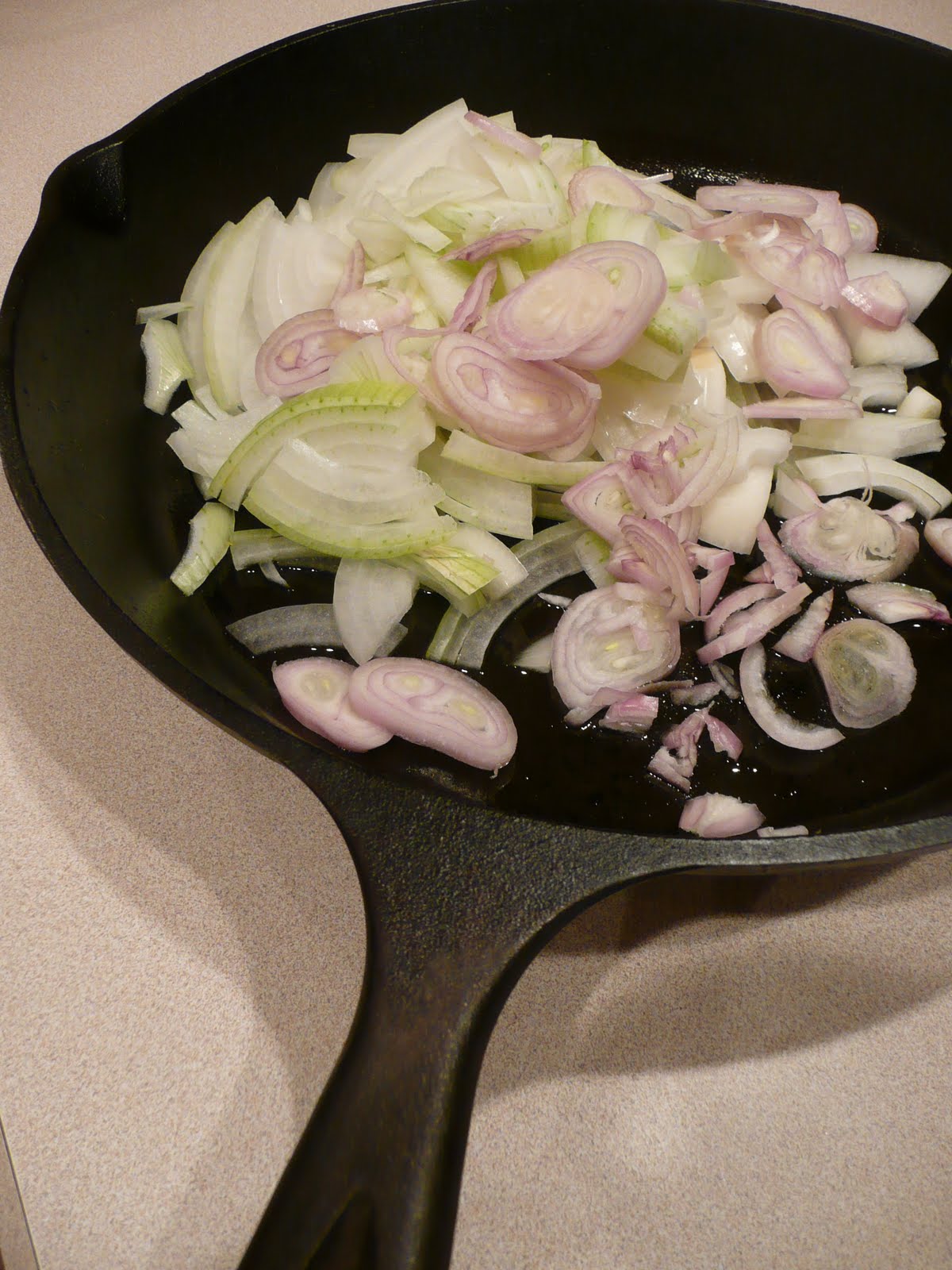
While the potatoes are cooking, place the olive oil in a large skillet (I prefer cast iron) over medium heat. Add the onion and shallot and cook, stirring frequently, until the onions begin to take on color. About 15 minutes into the cooking, add the 1/4 t. salt to the onion mixture. Cook an additional 5-10 minutes, stirring frequently, until the onions are deeply caramelized but not burnt. (Turn down the heat if they begin to burn.)


Remove the onions from the heat and allow them to cool slightly. Place the onions in a food processor and pulse until they form a very smooth paste. Set aside.

In a small saucepan, combine the butter and skim milk and warm, over low heat, until the butter melts.
When the potatoes are fork-tender, drain them and return them to the cooking pot. Mash them using a ricer (my favorite method) or an old-fashioned potato masher. Add the butter mixture to the mashed potatoes and stir to combine. Add the brie and stir to combine. Add the sour cream and the pureed caramelized onions, stirring to combine. Season to taste with additional kosher salt and black pepper; serve immediately.

Makes 8 servings. Or, like, 3 servings, if you're wearing your traditional Thanksgiving spreadin'-out clothes.
But I labor under no illusion that Thanksgiving is about anything more than mashed potatoes. Oh sure, the holiday is about giving thanks, being grateful for what we have, breaking bread with loved ones. But it is mostly about potatoes. Pounds of them. Mashed with full-fat dairy.
And so. In the spirit of the Mashed Potato Club -- one of my favorite restaurants (now closed) that we used to frequent when I lived in Chicago -- this year I sought something interesting and maybe unexpected to add to my potatoes. The Mashed Potato Club was fabulous for its flamboyantly gay waiters and its hi-hat bass-thumping dance music atmosphere. It was also fabulous for its menu: rich mashed potatoes topped with any combination of nearly limitless toppings. I used to order mine with tomato, chiffonade of basil, grilled portobello mushrooms and mozzarella cheese. Which I washed down with several (many) cosmopolitans. It was a scene.
Though my kitchen does not resemble a gay bar-slash-mashed potato restaurant, I can keep the decadent memory of the Mashed Potato Club alive nevertheless. All I have to do is whip up a batch of these caramelized onion, shallot and brie mashed potatoes. While listening to Rent. If I had a disco ball, a mural of a naked gent and a mesh-clad Boystown resident to serve me drinks, I'd be in business.
But I digress. I'm guessing the majority of you out there can eat a plate of mashed potatoes without thinking of the soundtrack to Evita. Most of you quite reasonably associate mashed potatoes with Thanksgiving or with a rustic home-cooked dinner. And that's wonderful, too, as these potatoes will add an unexpected flair to the traditional Thanksgiving meal. Your guests are most likely expecting potatoes. They might not be expecting a mash laced with deeply caramelized onions and the mild, smooth flavor of brie.

Go ahead: mix it up. Even though Thanksgiving dinner truly is all about the potatoes, there's nothing that says they have to be plain.
++++++
CARAMELIZED ONION AND BRIE MASHED POTATOES
2 1/2 lbs. potatoes (whatever variety you like), peeled and cut into large cubes
2 T. olive oil
1/2 large white onion, thinly sliced
1/2 shallot, thinly sliced
1/4 t. kosher salt, plus more to taste
1/2 c. (1 stick) unsalted butter
3/4 c. skim milk
1/4 c. sour cream
8 oz. brie, rind removed, cubed
Freshly-cracked pepper to taste
Place the potatoes in a large pot of cold water, then place over medium-high heat. Cook the potatoes until they are fork-tender, which takes 10-15 minutes after the water comes to a boil.
While the potatoes are cooking, place the olive oil in a large skillet (I prefer cast iron) over medium heat. Add the onion and shallot and cook, stirring frequently, until the onions begin to take on color. About 15 minutes into the cooking, add the 1/4 t. salt to the onion mixture. Cook an additional 5-10 minutes, stirring frequently, until the onions are deeply caramelized but not burnt. (Turn down the heat if they begin to burn.)
Remove the onions from the heat and allow them to cool slightly. Place the onions in a food processor and pulse until they form a very smooth paste. Set aside.
In a small saucepan, combine the butter and skim milk and warm, over low heat, until the butter melts.
When the potatoes are fork-tender, drain them and return them to the cooking pot. Mash them using a ricer (my favorite method) or an old-fashioned potato masher. Add the butter mixture to the mashed potatoes and stir to combine. Add the brie and stir to combine. Add the sour cream and the pureed caramelized onions, stirring to combine. Season to taste with additional kosher salt and black pepper; serve immediately.
Makes 8 servings. Or, like, 3 servings, if you're wearing your traditional Thanksgiving spreadin'-out clothes.
Tuesday, November 10, 2009
Calorically Acceptable Thanksgiving Side Dish
It is November 10.
Somehow the calendar has advanced itself very close to Thanksgiving and nearly to the end of the year. Though it seems like the beginning of May was just a few weeks ago, alas, here we find ourselves...older, (perhaps) wiser, knocking on the holiday season's door once again. Where does the time go?
Well I for one know that I've spent the majority of this year baking bread. You'd be surprised at how quickly time flies while you're waiting for yeast to do its thing. But beyond that and a massive trip to Australia, I don't have much to show for 2009 -- except my home and my wonderful husband and my sweet dog. And now that I've written that down, it appears that I have an awful lot to show for 2009. An awful lot that counts. Here's hoping for a multitude of blessings in your life as well, dear reader.
And speaking of giving thanks, now's also the time to start talking about Thanksgiving dinner. It's time to order the turkey, to plan, to cook, to locate your spreadin'-out clothes in the back of the closet, to salivate in an inappropriate fashion. To help you plan for the big day, I've put together a collection of Stove With A House recipes that will fit in nicely on your Thanksgiving table -- whether you're hosting an army or need a dish to take to someone else's feast. Just click on the "Tasty Thanksgiving Recipes" link over there on the right and have a look. Happy cooking!

To kick off the season today, I'd like to share a recipe for twice-baked cauliflower that I dreamed up on my birthday. Husband took me to Downtown 140 for an amazing and absolutely filling multi-course extravaganza. There was an elaborate cheese course, and chicken curry spring rolls with a perfect cilantro sauce, and grilled heads of romaine with Parmigiano-Reggiano, and a rare steak for Husband, and Jamaican Blue Mountain coffee. Then there was my delectable entree: almond-crusted scallops with pomegranate served atop cauliflower mash. It was divine, and it got me thinking that I do not eat enough cauliflower.

I should be making more cauliflower mash at home, I thought while savoring my deeply caramelized scallops, especially since it is much healthier than mashed potatoes yet strikingly similar in taste and texture. But a few days later, after sending Husband to the store to pick up a head of cauliflower, I determined that I wanted something a little more exciting than a simple puree -- especially if I was to serve it during the holidays. I wanted to add just enough dairy goodness to elevate the humble cauliflower from Healthy Vegetable to Calorically Acceptable Thanksgiving Side Dish. You are planning on exercising that Thursday morning, right?

So I roasted the florets until they were brown and crispy, pureed them with butter and cream, then baked them again with panko and Manchego and a pinch of cayenne. Though Husband and I enjoyed the twice-baked cauliflower with coriander-dusted chicken paillards and a bit of sauteed spinach, it will also pair perfectly with a Thanksgiving turkey. And it will fit right in alongside the rest of the Thanksgiving side dishes, all gooey and crispy and browned in a casserole dish.

All gooey and crispy and browned in a casserole dish. I knew there was a reason I love Fall.
++++++
TWICE-BAKED CAULIFLOWER
I like to make this dish in individual oven-proof dishes, but you can, of course, bake the whole thing in a large casserole and spoon out individual servings. I just like my tiny yellow Pyrex baking dishes and use them whenever possible.
1 head cauliflower, cut into florets
3 T. olive oil
1/2 t. black pepper
1 t. sea salt
1/2 t. dried thyme
1/2 c. heavy cream
4 T. unsalted butter
Pinch cayenne
1/2 c. panko
4 oz. Manchego cheese, shredded
Preheat the oven to 350 degrees Fahrenheit. Place the cauliflower, olive oil, black pepper, sea salt and thyme in a baking dish and toss to combine. Roast until the florets are tender and brown and crispy on the edges, about 50 minutes. Remove from the oven and cool slightly; leave the oven on.
While the cauliflower is cooling, heat the heavy cream and butter in a small saucepan over low heat until the butter is melted. Remove from the heat.
Place the cauliflower and the cream-butter mixture in a Cuisinart. Add the cayenne and process until the mixture comes together and the cauliflower is chopped into tiny pieces -- it shouldn't be completely smooth; I like a little bit of texture.
Divide the cauliflower mixture into 4 single-serve oven-proof dishes.

Top each dish with 1/8 c. of the panko and 1 oz. of the Manchego cheese. (Alternatively, if you aren't using individual baking dishes, add the entire cauliflower mixture to one large baking dish and top with the entirety of the panko and Manchego.)

Bake for 20 minutes, until the cheese is bubbly and enticing.

Makes 4 servings.
Somehow the calendar has advanced itself very close to Thanksgiving and nearly to the end of the year. Though it seems like the beginning of May was just a few weeks ago, alas, here we find ourselves...older, (perhaps) wiser, knocking on the holiday season's door once again. Where does the time go?
Well I for one know that I've spent the majority of this year baking bread. You'd be surprised at how quickly time flies while you're waiting for yeast to do its thing. But beyond that and a massive trip to Australia, I don't have much to show for 2009 -- except my home and my wonderful husband and my sweet dog. And now that I've written that down, it appears that I have an awful lot to show for 2009. An awful lot that counts. Here's hoping for a multitude of blessings in your life as well, dear reader.
And speaking of giving thanks, now's also the time to start talking about Thanksgiving dinner. It's time to order the turkey, to plan, to cook, to locate your spreadin'-out clothes in the back of the closet, to salivate in an inappropriate fashion. To help you plan for the big day, I've put together a collection of Stove With A House recipes that will fit in nicely on your Thanksgiving table -- whether you're hosting an army or need a dish to take to someone else's feast. Just click on the "Tasty Thanksgiving Recipes" link over there on the right and have a look. Happy cooking!
To kick off the season today, I'd like to share a recipe for twice-baked cauliflower that I dreamed up on my birthday. Husband took me to Downtown 140 for an amazing and absolutely filling multi-course extravaganza. There was an elaborate cheese course, and chicken curry spring rolls with a perfect cilantro sauce, and grilled heads of romaine with Parmigiano-Reggiano, and a rare steak for Husband, and Jamaican Blue Mountain coffee. Then there was my delectable entree: almond-crusted scallops with pomegranate served atop cauliflower mash. It was divine, and it got me thinking that I do not eat enough cauliflower.
I should be making more cauliflower mash at home, I thought while savoring my deeply caramelized scallops, especially since it is much healthier than mashed potatoes yet strikingly similar in taste and texture. But a few days later, after sending Husband to the store to pick up a head of cauliflower, I determined that I wanted something a little more exciting than a simple puree -- especially if I was to serve it during the holidays. I wanted to add just enough dairy goodness to elevate the humble cauliflower from Healthy Vegetable to Calorically Acceptable Thanksgiving Side Dish. You are planning on exercising that Thursday morning, right?
So I roasted the florets until they were brown and crispy, pureed them with butter and cream, then baked them again with panko and Manchego and a pinch of cayenne. Though Husband and I enjoyed the twice-baked cauliflower with coriander-dusted chicken paillards and a bit of sauteed spinach, it will also pair perfectly with a Thanksgiving turkey. And it will fit right in alongside the rest of the Thanksgiving side dishes, all gooey and crispy and browned in a casserole dish.
All gooey and crispy and browned in a casserole dish. I knew there was a reason I love Fall.
++++++
TWICE-BAKED CAULIFLOWER
I like to make this dish in individual oven-proof dishes, but you can, of course, bake the whole thing in a large casserole and spoon out individual servings. I just like my tiny yellow Pyrex baking dishes and use them whenever possible.
1 head cauliflower, cut into florets
3 T. olive oil
1/2 t. black pepper
1 t. sea salt
1/2 t. dried thyme
1/2 c. heavy cream
4 T. unsalted butter
Pinch cayenne
1/2 c. panko
4 oz. Manchego cheese, shredded
Preheat the oven to 350 degrees Fahrenheit. Place the cauliflower, olive oil, black pepper, sea salt and thyme in a baking dish and toss to combine. Roast until the florets are tender and brown and crispy on the edges, about 50 minutes. Remove from the oven and cool slightly; leave the oven on.
While the cauliflower is cooling, heat the heavy cream and butter in a small saucepan over low heat until the butter is melted. Remove from the heat.
Place the cauliflower and the cream-butter mixture in a Cuisinart. Add the cayenne and process until the mixture comes together and the cauliflower is chopped into tiny pieces -- it shouldn't be completely smooth; I like a little bit of texture.
Divide the cauliflower mixture into 4 single-serve oven-proof dishes.
Top each dish with 1/8 c. of the panko and 1 oz. of the Manchego cheese. (Alternatively, if you aren't using individual baking dishes, add the entire cauliflower mixture to one large baking dish and top with the entirety of the panko and Manchego.)
Bake for 20 minutes, until the cheese is bubbly and enticing.
Makes 4 servings.
Monday, October 19, 2009
With the same memories
I've always loved Halloween. Which is interesting, because I've never been a huge fan of dressing up. If someone hands me a decent costume, most likely I'll wear it. But come up with something on my own? Not so much. I'm in awe of those cool people who show up at parties dressed as Uma Thurman from Pulp Fiction, over-sized syringe protruding gruesomely from the chest. (Did I just date myself? I know that movie came out in 1994; but still, that was a very memorable Halloween costume.)
But I do like bite-sized candies, and I love love love the fall, and my birthday is just a few days before Halloween. So there's not much not to like about October 31.

And in recent years I've discovered yet another reason to love the holiday: the homey, delicious meal that Sister serves on trick-or-treat night, after my nephews have filled their bags and exhausted their little ninja or pirate selves. It's a tradition that stretches back to when Sister and I were kids, when I was dressed up as Gizmo or a space girl or a vampire in a coffin (Dad, of course, constructed the coffin). Mom always prepared a stick-to-the-ribs meal for us, something hearty to counteract the pounds of sugar. I didn't pay much attention to those Halloween meals at the time; I had a pillowcase full of tiny Reese's Peanut Butter Cups to occupy my mind. But in retrospect, they make me very happy. They were warm, and loving, and comforting, and everything that is good about blissful, carefree childhood.
I suspect Sister cooks something special on Halloween night to provide her boys with the same memories that we have. Even though they totally don't know it now, maybe someday -- many years from now -- they'll remember fondly their mom's trick-or-treat meals. Sister always picks something robust, healthy and in season -- a soup flavored with autumn squash, turkey chili, stew. It perfumes the whole house, bubbling away, as the boys head out into the chilly air to collect their treats. By the time they return, the adults are full and happy. And looking to raid Nephews' haul for a sweet treat to end the meal.

This is where I step in, at least this year, with some pumpkin cookies. These rustic little treats feel right for fall, reliant as they are on their pumpkin flavor. They're also chock full of pleasing little nuggets like chocolate, toasted pecans and sweetened coconut. With all that, they're light, too: their texture is springy, almost spongy, which seems a contradiction with all those sweet bits suspended in the crumb. They're addictive. They're tailor-made for a Halloween night feast. And I know the adults will be grateful as they reach for a cookie (or three) to top off dinner.

Come to think of it, my nephews should thank me, too, for these cookies will save their trick-or-treat spoils from the paws of adults who (technically) should know better. Wait. Let me rephrase that. These cookies will save some of the boys' trick-or-treat spoils. I don't make any promises about the Reese's Peanut Butter Cups.

++++++
PUMPKIN-CHOCOLATE-COCONUT COOKIES
Pumpkin cookie base adapted very loosely from Betty Crocker's Cooky Book
1/2 c. shortening, at room temperature
1 c. light brown sugar, packed
1/2 c. dark brown sugar, packed
2 large eggs
1 3/4 c. canned pumpkin puree (I like the organic stuff, but I bet the authors of the Cooky Book did not!)
2 3/4 c. all-purpose flour
1 T. baking powder
1 t. cinnamon
1/2 t. freshly-grated nutmeg
1/4 t. ground ginger
1/2 t. kosher salt
3/4 c. pecans, toasted
1/2 c. sweetened coconut
1 c. semi-sweet chocolate chips
Preheat the oven to 400 degrees Fahrenheit. Combine the shortening and both brown sugars in the bowl of an electric mixer. Cream together using the paddle attachment until the shortening and sugar is well-combined. Add the eggs and beat to combine thoroughly. Add the pumpkin puree and mix to combine thoroughly.
Sift the flour, baking powder, cinnamon, nutmeg, ginger and salt into a medium bowl. Add the dry ingredients to the pumpkin mixture in three additions, mixing well to incorporate each addition. Add the pecans, coconut and chocolate chips and mix briefly to combine.

Using a spring-loaded ice-cream scoop, drop the batter onto ungreased baking sheets. (The cookies don't spread very much, so you can fit lots on one sheet.) Bake for 12-14 minutes, rotating the sheet 180 degrees half-way through the baking time. Remove from the oven and cool on the baking sheet for 2-3 minutes, then transfer to a cooling rack.

Makes about 6 dozen cookies.
But I do like bite-sized candies, and I love love love the fall, and my birthday is just a few days before Halloween. So there's not much not to like about October 31.

And in recent years I've discovered yet another reason to love the holiday: the homey, delicious meal that Sister serves on trick-or-treat night, after my nephews have filled their bags and exhausted their little ninja or pirate selves. It's a tradition that stretches back to when Sister and I were kids, when I was dressed up as Gizmo or a space girl or a vampire in a coffin (Dad, of course, constructed the coffin). Mom always prepared a stick-to-the-ribs meal for us, something hearty to counteract the pounds of sugar. I didn't pay much attention to those Halloween meals at the time; I had a pillowcase full of tiny Reese's Peanut Butter Cups to occupy my mind. But in retrospect, they make me very happy. They were warm, and loving, and comforting, and everything that is good about blissful, carefree childhood.
I suspect Sister cooks something special on Halloween night to provide her boys with the same memories that we have. Even though they totally don't know it now, maybe someday -- many years from now -- they'll remember fondly their mom's trick-or-treat meals. Sister always picks something robust, healthy and in season -- a soup flavored with autumn squash, turkey chili, stew. It perfumes the whole house, bubbling away, as the boys head out into the chilly air to collect their treats. By the time they return, the adults are full and happy. And looking to raid Nephews' haul for a sweet treat to end the meal.
This is where I step in, at least this year, with some pumpkin cookies. These rustic little treats feel right for fall, reliant as they are on their pumpkin flavor. They're also chock full of pleasing little nuggets like chocolate, toasted pecans and sweetened coconut. With all that, they're light, too: their texture is springy, almost spongy, which seems a contradiction with all those sweet bits suspended in the crumb. They're addictive. They're tailor-made for a Halloween night feast. And I know the adults will be grateful as they reach for a cookie (or three) to top off dinner.
Come to think of it, my nephews should thank me, too, for these cookies will save their trick-or-treat spoils from the paws of adults who (technically) should know better. Wait. Let me rephrase that. These cookies will save some of the boys' trick-or-treat spoils. I don't make any promises about the Reese's Peanut Butter Cups.

++++++
PUMPKIN-CHOCOLATE-COCONUT COOKIES
Pumpkin cookie base adapted very loosely from Betty Crocker's Cooky Book
1/2 c. shortening, at room temperature
1 c. light brown sugar, packed
1/2 c. dark brown sugar, packed
2 large eggs
1 3/4 c. canned pumpkin puree (I like the organic stuff, but I bet the authors of the Cooky Book did not!)
2 3/4 c. all-purpose flour
1 T. baking powder
1 t. cinnamon
1/2 t. freshly-grated nutmeg
1/4 t. ground ginger
1/2 t. kosher salt
3/4 c. pecans, toasted
1/2 c. sweetened coconut
1 c. semi-sweet chocolate chips
Preheat the oven to 400 degrees Fahrenheit. Combine the shortening and both brown sugars in the bowl of an electric mixer. Cream together using the paddle attachment until the shortening and sugar is well-combined. Add the eggs and beat to combine thoroughly. Add the pumpkin puree and mix to combine thoroughly.
Sift the flour, baking powder, cinnamon, nutmeg, ginger and salt into a medium bowl. Add the dry ingredients to the pumpkin mixture in three additions, mixing well to incorporate each addition. Add the pecans, coconut and chocolate chips and mix briefly to combine.
Using a spring-loaded ice-cream scoop, drop the batter onto ungreased baking sheets. (The cookies don't spread very much, so you can fit lots on one sheet.) Bake for 12-14 minutes, rotating the sheet 180 degrees half-way through the baking time. Remove from the oven and cool on the baking sheet for 2-3 minutes, then transfer to a cooling rack.
Makes about 6 dozen cookies.
Subscribe to:
Posts (Atom)