skip to main |
skip to sidebar
Multigrain bread extraordinaire!

Such a name deserves an exclamation point. I think all breads should have such names: casatiello magnifique! Kaiser rolls eleganza! English muffins especial! However, sadly, in his excellent The Bread Baker's Apprentice, bread enthusiast and expert baker Peter Reinhart opts for the more sensible, straightforward names: casatiello. Kaiser rolls. English muffins.
Until you get to page 187, where for some reason Reinhart was moved to title his multigrain loaf, "Multigrain bread extraordinaire." It seemed a little randomly enthusiastic, especially for a nutritious bread that might not otherwise inspire such joie de vivre. Speaking for myself, I tend to get a little more excited by, say, a brioche made with enough butter to fill the business end of a dump truck. Brioche extraordinaire! That, I could expect.

But then I made the dough for the extraordinary multigrain bread. And in its bountiful rustic healthful glory, it rose so high atop its pan as to make me blush a little.

I baked it, and witnessed its surprisingly soft crumb flake away from its delicate crisp crust. I then took Reinhart's advice: "This bread...makes the best toast in the world." I browned a few slices in the trusty toaster oven, anointed them with an "appropriate" amount of salted Irish butter, and promptly enjoyed the best toast in the world.

Extraordinaire!
++++++
The Bread Baker's Apprentice challenge asks that we do not share Peter Reinhart's recipes, no matter how extraordinary or pedestrian. But you have the book. So turn to page 187 already!
++++++
Previously, on A Stove With A House Around It:
One year ago: crispy chicken tacos
Two years ago: mustard chicken in phyllo
Three years ago: cream of mushroom soup
"I could see why Seinfeld would steal one of those," Husband said.
He was, of course, referring to the time Jerry stole a marble rye from Mrs. Choate in order to sneak it into the Ross house so George could replace the one his parents took back when Mr. and Mrs. Ross didn't serve it with dinner. "Shut up, you old bag!" Jerry shouted, tucking the swirled rye under his arm.

Though I would consider committing a crime in order to procure a marble rye, now I don't have to, thanks to Peter Reinhart. Which is good for many reasons, not the least of which is: should I ever be brought up on some charges related to a Good Samaritan law in New England, the prosecution won't be able to haul any marble rye-spurned old ladies before the jury to disparage my character.
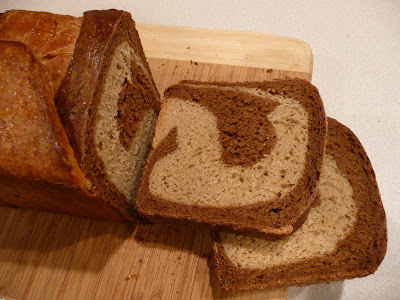
The most difficult part about making this bread is getting your hands on the specialty flours. Well, it's not difficult, per se, it just involves a bit of planning. To achieve the bread's lovely dark-light mottling -- as well as the distinctive, wonderful rye flavor -- you'll need white rye flour, clear flour and caramel coloring. Thanks to the ever-stellar King Arthur Flour, these flours are only an Internet order and a few days' wait away. (For the record, Reinhart's recipe calls for liquid caramel color to dye the dark portion of the marble rye. King Arthur Flour only had the caramel powder. It worked just fine and didn't leave behind any of the bitter flavor that coloring the dough with cocoa or instant coffee would.) The day I ordered my flour I decided that I would spoil myself and load up on all the specialty flours I'd need for the remainder of the Bread Baker's Apprentice challenge. The following bounty arrived on my front porch 72 hours later. You don't necessarily have to be this ridiculous, but I'm not gonna lie: it was glorious. And yes, I lined them all up on my counter like the massive nerd that I am.

Of my two-loaf yield, I ate one marble rye right away and stashed the second in the freezer for a snowy day. The crust was shiny and rich, with a sturdy but soft crumb inside. I usually enjoy thick-sliced and dark-toasted bread, but the marble rye was very tasty cut thinly and toasted lightly. Like seemingly everything else in my life, I loved this bread even more with a little bit of fancy salted butter.

And because I baked it myself, I didn't have to fish for it out the bedroom window of my in-laws' townhouse. Hey, it's a Schnitzer's.
++++++
The Bread Baker's Apprentice challenge asks that we do not share Reinhart's recipes on the dot-com. Meanwhile, you don't need it anyway, because you've already purchased the book. (And if you haven't done so yet, go do it now. I'll look the other way and pretend you've had it all along.) The marble rye recipe starts on page 183.


I've submitted these marble rye loaves to Yeastspotting because they are so lovely, if I do say so myself.
++++++
Previously, on A Stove With A House Around It:
One year ago: layered chocolate fudge cake
Two years ago: graham crackers
Three years ago: whole-wheat spaghetti with Meyer lemon, arugula and pistachios
Please forgive the vulgarity, but I just have to say it: Holy crap! I baked some bread today!

I mean, seriously! I baked bread! It's been so freaking long since the last time I baked bread that I really thought my days of absolutely needing such specialty items as a dough whisk and a couche in my kitchen were over. There wasn't even any good reason for my hiatus. I can't blame lack of time: making homemade bread requires very little active time -- just lots of rising time. I can't blame lack of supplies: my pantry is full of flours, from cake all the way up to high-gluten. I can't blame anything, really, except my sorry-ass self. I forgot how easy -- and how tremendously rewarding -- it is to bake your own bread.

So, back I go to The Bread Baker's Apprentice challenge. I swear I am going to finish this thing, I swear. You see, I attended* a three-night cooking class with Peter Reinhart himself at the Western Reserve School of Cooking in June and was inspired anew to immerse myself in all things yeast. Unfortunately, I was way way pregnant and that inspiration was sapped rather quickly by my need to watch old episodes of "Saved By the Bell" in bed. What can I say.
Peter was awesome, though, and very supportive of The Bread Baker's Apprentice challengers (one of my fellow bakers -- Phyl of Of Cabbages and King Cakes, who very long ago rather impressively completed the challenge -- was also in attendance). I learned a lot during those three nights, but my favorite lesson was the realization that I can totally make these breads just as well as Peter can. The delicious samples he shared with the class were amazing, but not much different than the finished breads that come out of my kitchen. Which is not to say that I am so awesome, but rather to say that Peter is a fabulous teacher whether in person or via the pages of a book. It is also to say: bread-making, while seemingly difficult and often perceived as beyond the scope of everyday home cooking, is completely accessible and easily accomplished with just a small investment of time and patience.

Peter was focused almost solely on his Artisan Breads Every Day book, which emphasizes the no-knead method. Not having any experience with no-knead breads, I was fascinated to see just how much gluten can be developed just with a little time and zero effort. Light bulb! The first night was dedicated to multi-purpose lean dough, challah and sweet dough for cinnamon and sticky buns. The star of night number two was focaccia. And on the last night Reinhart gave us pizza dough. So much pizza dough, topped with everything from caramelized onion marmalade to pesto to fresh Roma tomatoes and bright parsley.


Having already completed part of The Bread Baker's Apprentice challenge prior to the classes, there was a lot in the Peter Reinhart canon that I already knew. But that certainly didn't mean there wasn't a lot to learn. For example:
- Use parchment on your peel. I have yet to master the smooth use of the pizza peel; I dust my peel liberally with corn meal or semolina before placing the pizza dough on it, but I can never get the dough to slide effortlessly onto the pizza stone without making a giant mess. Peter's solution: place parchment on the peel, then add the dough, then slide the whole thing off the peel onto the stone. Well, duh. Why didn't I think of that? Brilliant.
- Contrast is a powerful culinary principle. I knew there was a reason I liked salty with my sweet, and crispy-crunchy with my soft and tender. It is the reason why I work to create a thick, chewy crust on a loaf of hole-y ciabatta.
- Whole wheat flour absorbs more water than white flour, so to convert a white flour recipe to whole wheat you'll have to add an extra 8-10% hydration to the mix. Very good to know.
- The baker's job is to evoke the full potential of flavor that's trapped inside the grain.
- Peter's definition of baking, oft repeated during the course of the three nights is as follows: "Baking is the application of heat in an enclosed environment for the purpose of driving off moisture."
As interesting and informative as these random tidbits are -- culled from the margins of my class notes -- Peter was at his very best when he was letting his seminarian past shine. A one-time member of a holy order, Peter described the act of baking his breads with spiritual metaphor that is more earthy than preachy. Call it the gospel of grain: "Bread is a transformational food," he says, describing the process of taking the living wheat, grinding and milling the life out of it in the process of making flour, then infusing it anew with yeast. Baking then kills the yeast, creating bread, which we eat to sustain our own lives. In the wrong hands, such metaphor could be annoying. But with Peter, it is passionate and honest and sincere, born of a simple love of bread and respect for wheat that produces some of the best loaves you'll ever taste.

And you know what? Bread is transformational, as much as it is elemental to human existence, nourishment and joy. The very best thing I learned those nights is a practical message that any novice bread baker can appreciate: even if your bread fails, people will still love it because it's homemade. "It is always a hit no matter how it comes out."
*Please note: Dad bought the classes for me for Christmas last year. Let it not be said that I failed to acknowledge him publicly for this awesome, most perfect gift. And not only is he generous, but he's handsome, too!


++++++
So it seems I've used the occasion of the next challenge recipe -- light wheat bread -- to pontificate about Peter in person. Alliteration aside, let me tell you a little about this bread. It's the only loaf I had made prior to starting The Bread Baker's Apprentice challenge, as it's the only recipe in the book that doesn't require more than one day of fermentation. The dough produces a lovely golden sandwich loaf, flecked with whole wheat and ever so slightly sweetened with a touch of honey. The crust is crunchy and firm and the crumb is soft and pocked with small, pleasing holes (see above regarding the importance of contrast).

This is the bread I made when I vowed, oh so long ago, that I would bake all my own bread. I even kept up with it for about a month, churning out a loaf every few days. I need to pick up that habit once again, for light wheat bread is delicious, and satisfying, and easy, and what the hell. Stop reading this and go and bake some.

++++++
The Bread Baker's Apprentice challenge asks that we do not share the recipes for the challenge loaves. However, I have it on good authority that you can find the recipe for Reinhart's light wheat bread on the excellent and lovely Smitten Kitchen blog. I'm just sayin'. However, if you're feeling that now is the time to buy Reinhart's book -- hello, finally here's a bread that can be baked in just one day! -- head on over to Amazon and pick up a copy. The recipe starts on page 181.
Finally, in honor of my triumphant return to bread-baking, I have submitted this here light wheat bread to Yeastspotting.
++++++
Previously, on A Stove With A House Around It:
One year ago: sesame butter cups
Two years ago: pizza Margherita and pizza with sage-walnut pesto and gorgonzola
The last time I baked from The Bread Baker's Apprentice, Conan O'Brien was still on NBC. They were lighting the Christmas tree at Rockefeller Center. Winter was on its way, and I was, how do you say, with child even though I didn't know it yet. For someone who claimed that she was going to make all her own bread from now on, it has been a long, lonely hiatus indeed.

But I always knew I'd return. I'd watch the blogs of my fellow Bread Baker's Apprentice challengers as they baked loaf after loaf, speeding through the book with yeasty abandon while I was stuck in the never-never land between kaiser rolls and lavash crackers. I wondered if I'd been left behind, lapped many times over by more enterprising bakers who were already deep into the Ps. But I took solace in the fact that we were all permitted to go our own pace (even our dear leader was slowing up a tad). I knew it wasn't a race. I knew someday soon the bread-baking urge would strike again.

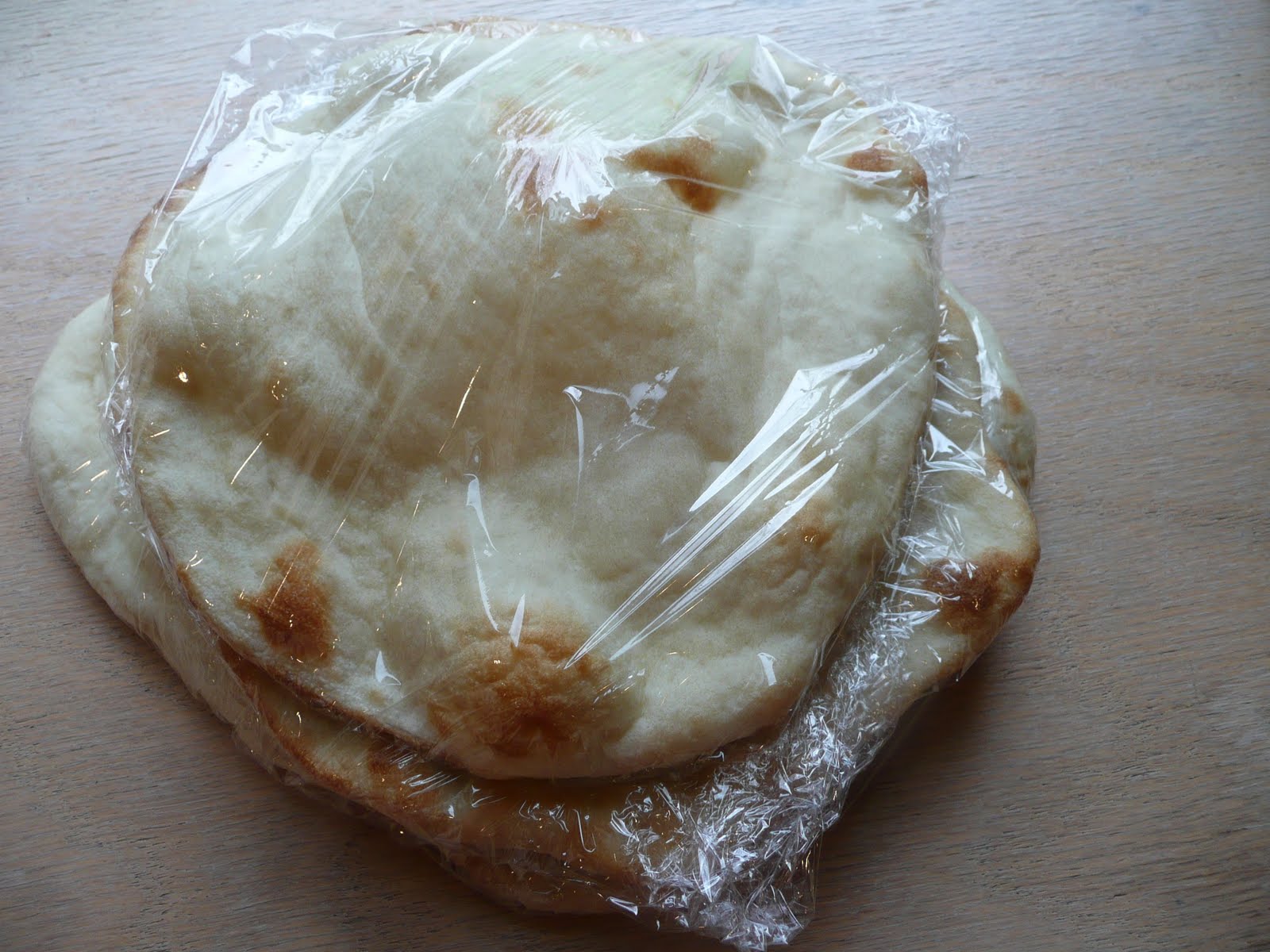
Part of my lag had to do with the fact that I was stuck on lavash crackers -- a recipe I had attempted before, for the Daring Bakers back in September 2008. I liked the crackers when I made them back then, but I wasn't totally enthusiastic to make them again. So I kept putting it off. And putting it off some more. Until one day a few weeks ago when -- staring at the lavash cracker recipe, willing my hands to begin working with flour -- I noticed a note in the margin. It said that the lavash cracker dough can also be used to make pita bread.

And thus was revealed the answer for which I had been waiting all these months: I could make the lavash crackers without really making the lavash crackers, while at the same time attempting homemade pita -- something I'd been hankering to do for a long, long time. I was a baker with a plan, a woman on a mission. No longer stalled on lavash, I was ready to take up the glorious mantle of the Bread Baker's Apprentice once again. I hoped my fellow bakers hadn't given up on me.

I made the pitas this past weekend and they were so amazing (and easy) that I had to make another batch, right away. I had forgotten how simple it is to make one's own bread, and how truly delicious the result. These pitas are especially easy: one quick 90-minute rise, a flattening trip under the rolling pin and just a few minutes on a 500-degree baking stone and -- hey! -- just like that, homemade pita. People will marvel at you when you present a big tray of hummus, veggies and pita and then explain that you made the bread yourself. Then they will marvel some more when they actually taste the soft pita, which is so much tastier than the store-bought stuff. (It is up to you whether you wish to divulge how easy it is to make your own.)
So here I go again. Just yesterday I vowed that I will always make my own pita from scratch, never again to reach for the grocery variety. I am again full of vigor and enthusiasm for bread baking. It's nice to be back.

++++++
The Bread Baker's Apprentice challenge asks that we do not share Reinhart's recipes. That said, if you are the least bit enterprising, you can find the lavash cracker recipe elsewhere on this blog (and linked to from elsewhere in this post). Even so, I know you all have the book anyway, so turn to page 178 and begin making pita, or crackers, or both.
The pita instructions can be found in the margins of page 178. A few pita-notes: First, the lavash cracker recipe as written makes only four 3-oz. pitas (or two larger 6-oz. pitas). That is woefully inadequate. I choose to double the lavash cracker dough and make eight 3-oz. pitas, which are a good size for sandwiches and for cutting into hummus-dipping wedges. Second, the process: preheat the oven to 500 degrees Fahrenheit, with a stone inside if you have one. Take the finished lavash cracker dough (after it's risen for 90 minutes and doubled in bulk) and then divide it into 8 equal portions. Roll out each portion until it's a circle a little less than a quarter-inch thick. Bake the rounds directly on the 500-degree stone. Third, I had great success baking the pitas on a stone, though the recipe states they can be baked on a parchment-lined baking sheet. Finally, the pitas only need a few minutes in the oven to begin to puff. Take them out right when they puff, and before they begin to take on color. If you let them brown in the oven, they will be much too crispy and crackery for traditional pita purposes (but the dog and probably your husband will still like them).
PS. I'm submitting these pitas to Yeastspotting because I am thrilled by them and choose to act like I am the first person in the world who has ever baked pitas at home.
And for one last piece o' business, check out these other Bread Baker's apprentices and their lavash successes:
++++++
Previously, on A Stove With A House Around It:
One year ago: Tim Tam cheesecake
Two years ago: truck-stop cinnamon rolls
I feel like I'm becoming a broken record on this Bread Baker's Apprentice business:
"I do not wish to overstate it, but really, this is (so far) my favorite recipe from The Bread Baker's Apprentice, hands down." "And? This focaccia is good. Damn good.""However, were I not about to fly about as far as one can fly without starting back the other way, I'll tell you what I'd be doing: I'd be baking more English muffins. Because Reinhart's recipe is e-asy. Easy! And the resulting muffins -- especially if fork-split, toasted and slathered with a teaspoon of homemade blueberry jam -- are so much more delicious than anything anyone named Thomas ever baked.""But as it is, Reinhart's cinnamon buns are so amazing I don't know if I'll ever have a need to go back. You live, you learn. You bake a better cinnamon bun.""Trust Peter on this one: a long cold fermentation engenders amazing bagels, bagels that are good enough to turn a person with tepid feelings about bagels into a person who has to eat the entire batch, like, now."It makes one wonder if I possess the ability to be critical.
To be fair, I wasn't a huge fan of Reinhart's French bread, strawberry-walnut celebration bread or corn bread. I mean, they weren't terrible, but they weren't favorites either. Chalk it up to Reinhart's overall brilliance, however, that I am only lukewarm on three of the 16 breads I've baked so far. I'd say that's a winning percentage.

Thus it logically follows that I found today's bread -- kaiser rolls -- to be absolutely amazing. You can quote me on that.

Reinhart's kaiser rolls are easy to make and they bake into large, well-risen rolls that are tender and airy on the inside, crusty and textural on the outside. They look really, really pretty and they taste even better. The only complaint I can possibly muster is that the recipe only makes six rolls. Six rolls! Six rolls disappear in no time. A word to the wise: make two batches. Or four. Or six, like I did.


I used my kaiser rolls as the foundation for savory, salty fried egg sandwiches. I also used them for hot turkey sandwiches, which I slathered with homemade thousand island dressing studded with my homegrown and canned dilly beans. Those two lunches were two of the best lunches I've had since Mom and I ate fish and chips at Fort Denison and enjoyed pies from Harry's Cafe de Wheels in Woolloomooloo. Which is saying a lot.

Meanwhile, what does it say about me that far more often than not I'm hesitant to move to the next Reinhart recipe, preferring instead to stay where I am, baking the current bread over and over again? Maybe it says that I am a whore for yeast, especially tried-and-true yeast. Maybe it says that I am easily pleased (though ask Husband, and you might get a different answer to that question). But then again maybe it says that I know a good thing when it comes along (again, see: Husband).

++++++
The Bread Baker's Apprentice challenge asks that we do not post Reinhart's recipes. But you all have the book by now already, so no biggie. Turn to page 175 to start making kaiser rolls over and over and over again.
PS. I'm submitting these kaiser rolls to Yeastspotting, because I'm so proud of their deliciousness that I wish to share them with the whole yeast-loving world.
Today I bring you a very special episode of the Bread Baker's Apprentice challenge. No, it doesn't involve Meredith Baxter Birney and has nothing to do with that one episode of "Family Ties" where Alex P. Keaton's friend died and he spent most of the episode reciting a monologue into the camera while the kitchen set behind him faded to black.*
No, this Italian bread is very special because Husband baked it.

OK, he didn't really bake it. But he did divide the pre-ferment (in this case, a biga) into 10 equal pieces that I then could incorporate into the bread dough. When I arrived home and the biga pieces were cut and ready to go, Husband stated plainly, "See? I'm baking. You're welcome."

And am I ever glad he decided to bake. Peter Reinhart's Italian bread is amazing...simply amazing. I do not wish to overstate it, but really, this is (so far) my favorite recipe from The Bread Baker's Apprentice, hands down. It's so good that I've already made it twice this week. It is my new go-to homemade bread.

The method involves making the aforementioned biga, letting it proof, then allowing it to chill in the refrigerator at least overnight. Then you ask your husband to cut it into 10 pieces for you. Then you mix those pieces with bread flour, salt, sugar, yeast, diastatic malt powder, olive oil and water. Some mixing, some kneading, some proofing, some hearth baking, some magic.

This Italian bread is crusty on the outside, tender on the inside. It's wonderful to eat spread with soft butter, toasted with oil, black pepper and garlic powder, fried in a skillet with an over-medium egg or just torn off the loaf in big, unseemly hunks. I took two loaves to Sister's house last night to serve with her trick-or-treat night feast (this year she made chicken noodle and winter vegetable soups). Husband couldn't come along, as he was working, and it was all I could do to save him a few pieces. I've not seen two loaves of bread disappear so quickly in quite some time.

I'm very pleased Husband's foray into bread-baking turned out so well. Next, he shall learn to shape Kaiser rolls.
*I did not fully appreciate this in the 1980s, but the Keatons had a really bitchin' stove.
++++++
The Bread Baker's Apprentice challenge does not wish for us to share Reinhart's recipes. However, even if you don't have anyone to divide your biga for you, get yourself to page 172 of the book and start working. I'm even thinking of starting a few more loaves today -- even though I baked two yesterday. Peter Reinhart's Italian bread = seriously addictive.
And I'm not the only one who thinks so. Check out some of my fellow Bread Bakers' takes on delicious Italian bread:
PS. I'm submitting this post to Yeastspotting, because of all the yeast I've personally spotted in the past year, this has been my favorite.
It was French bread that started me on this whole bread-baking odyssey in the first place.

I took the first step back in March, when I wrote about Dad's French bread: "I can see why this recipe was one of his favorites: it is extremely simple -- fool-proof, even -- and utterly delicious. It's a great place for me to start on my Bread-Making Quest." I was determined to bake bread regularly, but I assumed that my quest would be my own quiet pursuit. I thought it would be something I did for myself and my family, maybe occasionally sharing a bread or two here in this space.
However, less than two months later, I found myself on an actual Bread-Making Quest: The Bread Baker's Apprentice challenge. Which has taught me more about bread-making in 14 recipes (so far) than I ever imagined it would. When I vowed to make my own bread all the time, I didn't really think I'd be making complex artisan recipes week in, week out. But here I am: in a position to critique Dad's tried-and-true French bread against Peter Reinhart's version. In March I thought I'd be making modest sandwich loaves each Sunday; I didn't think I'd get to the point of comparing homemade baguette recipes. That seemed a tad hardcore, beyond the casual bread-baker I thought I'd become. What a glorious turn of events!

So here I sit with three of Reinhart's French bread loaves: deep golden, crusty, fragrant. Apart from the misshapen loaf that I had to bend to make it fit on the stone (Husband nicknamed this loaf "Snakey"), these baguettes almost look like they came from a professional oven. Which is wild!
 (Guess which one is Snakey.)
Reinhart's method involves making a pâté fermentée, which is a pre-ferment that in this case is in a 1:1 ratio with the final dough (meaning the pre-ferment has the same amount of flour, salt, yeast and water as the dough itself). The pâté fermentée has to sit at least overnight, so this French bread is certainly more time-consuming than Dad's recipe (which can be made in an afternoon). Reinhart's loaves are hearth-baked, meaning baked on a stone with repeated blasts of steam during the first two minutes of baking. Dad's loaves are baked alongside a pan of boiling water and the loaves themselves are brushed twice with water. The science behind both loaves is similar, but the execution and the result (in terms of the crust's appearance) are quite different. Dad's loaves are paler, not as crusty, while Reinhart's loaves are golden and shatter when bitten. Mmmm...shatter when bitten....

Anyway. Crust appearance is important, of course, but the real test is taste. And on that, I have to give props to Dad. While I might look Parisian walking down the street with one of Reinhart's loaves in my tote, I'm much happier with the flavor of Dad's bread. For Dad's is yeasty and aromatic and just a teeny eensy bit salty. Reinhart's French bread is these things, too, but in smaller measure. It just left me wanting; I had hoped it would taste as complex and beguiling as it looked, and it didn't.
Mom and Dad came over the other night to deliver some olive oil-rosemary cake (yum) to me and Husband. I was in the middle of making Reinhart's French bread: the shaped baguettes were proofing on the counter and The Bread Baker's Apprentice was open to the recipe. I noticed Dad peering over at the pages and could see his wheels turning, comparing what he was reading to his own time-tested French bread method. I knew he was thinking, "My recipe is better than this. It tastes amazing and I don't have to mess with no pâté fermentée. She thinks she is onto something here, but if she wants French bread, all she needs is that tattered old index card of mine." At the risk of inflating his ego, he is right. Though I like having Reinhart around, all I need -- in this case, at least -- is that old index card.
Advantage: Father. Well played. (And I'm not just saying that so he'll lend me his leaf blower.)
++++++
The Bread Baker's Apprentice challenge asks that we do not share Reinhart's recipes. But since you all have the book by now, turn to page 168 and get going. Then go over here and try Dad's recipe. And let me know what you think.
Also check out some French breads made by other Apprentices:
- Nicole from Pinch My Salt also baked a (slightly) misshapen loaf!
- Michelle at Big Black Dog has great success with her baguettes and makes a delicious-looking cognac-flavored crostini.
- Pete Eatemall eats three-quarters of one baguette while photographing it. I can totally get behind that.
- Daniel from Ahrelich Gesagt compares his baguette to a Poilâne loaf, which is never a good idea.
- Over at Italian Food Forever, Deb's loaves look gorgeous on her window sill.
It's been a long, long time since Peter Reinhart and I have spent any quality time together. Almost two months, in fact. I used to go weeks and weeks and weeks between bread-baking; not making homemade bread for two months was a rather normal occurrence. That is, of course, until I started baking with Peter. Peter alters your perception of what is "normal" regarding the amount and frequency of home bread-baking. In a good way.

I was totally on schedule through the first 12 breads of The Bread Baker's Apprentice challenge: one per week, truckin' right along. But then I went to Australia, and my three-week vacation turned into a six-week yeast hiatus. Yes, yes, there was significant jet lag when I arrived back in Ohio. But there was also the somewhat pathetic fact that it just took me longer than usual to pick up with my real-life habits and routines. Case in point: it took me at least a week and a half to feel like cooking dinner (thank goodness for Husband and his mad culinary skillz). And I was making these incredibly easy and utterly lame to-do lists, like Monday: go through the mail. Tuesday: pick some of the ripe tomatoes. Wednesday: clean the kitchen in an extremely cursory fashion. Thursday: unpack socks. And when I'd accomplish the day's task, it was sofa time. I was physically unwilling to do more than one chore on any given night.
Did I mention I still haven't put away my suitcases? Yeah. I haven't exactly been focused on picking back up with The Bread Baker's Apprentice challenge.

But there is one thing I have learned: there is safety in numbers. I mentioned on Twitter the other day that I was feeling very guilty about my bread-baking break. I was hoping that my co-challengers still loved me. Within moments many of them (including our fearless leader!) chimed in that they were behind schedule, too. I exhaled and prepared to make the next bread -- focaccia -- this weekend.

And? This focaccia is good. Damn good. Shouldn't-have-waited-so-long good. Why-put-away-the-luggage-now?-you'll-probably-need-it-over-the-holidays good.

Reinhart's focaccia method is a lot like his ciabatta method: that is, a wet dough that involves much stretching and folding. As with my ciabatta, my focaccia dough could have been wetter, because the holes in my finished product weren't as large as they could (should) have been. Regardless, it's an exquisite bread, awash during its several rises in a copious amount of herb-infused oil. When making it you will think, Really? This much olive oil? Certainly I am about to cause a fire in my oven. But no! The bread miraculously absorbs all the oil that gets "dimpled in" with the tips of your fingers, resulting in a flavorful, crisp-around-the-edges and rich bread. Reinhart offers many suggestions for toppings, but I went simple with a rough chop of the herbs that are still alive on my Northern Hemisphere mid-October back porch: rosemary, sage, flat-leaf parsley. I also added a little garlic powder, gray sea salt and freshly-cracked black pepper.

Husband is out of town for work this weekend. I sent him a photo of the cooling focaccia and he called me, breathlessly, saying "I want your bread" in a hushed, vaguely creepy tone. Normally an 11" x 17" slab of bread would stick around for a few days, at least until Husband gets home. But with this focaccia I'm thinking: not so much. It will be gone long before "Glee" airs on Wednesday. Sorry, dear.

++++++
The Bread Baker's Apprentice challenge asks that we do not post the recipes from Reinhart's book. But if you've taken a recent bread from flour, yeast and water, I can't think of a better time to dive back in. Turn your copy of the book to page 159 and rediscover how awesome it is to have home-baked bread in the house.
Additionally, you may wish to turn your attention to some of my fellow Bread Bakers and their excellent focaccia:
- Carolyn at Two Skinny Jenkins also thinks this is the best focaccia she's ever had.
- Way More Homemade's Donna experiments with freezing Reinhart's focaccia dough.
- Flour Girl Heather wants to make a focaccia topped with dried cherries and scallions. Intriguing!
- Jeff at Culinary Disasters tops his focaccia with an enticing mix of several varieties of caramelized onions. I'm having a Pavolvian response just thinking about it.